
Kenyan SMEs can compete online more effectively than ever before — but only if they treat their website as a serious business tool, not a digital afterthought. According to the Kenya National Bureau of Statistics, SMEs account for over 98% of all businesses in Kenya and contribute roughly 30% of GDP. Yet a striking majority still lack websites that reflect the quality of their products and services. The result? They cede enormous digital ground to larger, better-resourced competitors.
This guide is your blueprint. Whether you run a boutique in Westlands, a logistics firm in Mombasa, or a salon in Kisumu, you'll leave here knowing exactly what web design decisions will give your small business a genuine competitive edge online.

Why Web Design Is the Great Equaliser for Kenyan SMEs
In the physical world, a megastore has advantages a small shop can't match: location, foot traffic, and brand recognition. Online, those advantages collapse. A well-designed website built by a Nakuru-based SME can appear right next to — or above — a Nairobi corporate in Google search results. A Mombasa tour operator with a clean, fast, mobile-friendly site can outconvert a bigger rival with a clunky desktop-only page.
Web design is not decoration. It is the totality of how your business communicates trust, value, and ease of doing business. Every font choice, button placement, page load time, and contact form either builds confidence or erodes it. For an SME, where every lead counts, these micro-decisions compound into macro results.
"Your website is your most hardworking employee. It's open 24/7, speaks to thousands simultaneously, and either closes the sale — or loses it — before you even pick up the phone." — Web strategy principle, widely accepted across digital marketing circles
Best Web Hosting for Kenyan SMEs
Vetted local and Africa-focused hosts — chosen for reliability, local support, and value for money.
- Free .co.ke domain name with hosting plans
- Free SSL certificate on all plans
- LiteSpeed-powered shared hosting
- Imunify360 malware protection built-in
- cPanel control panel — beginner friendly
- 24/7 Kenya-based customer support
- 1-click WordPress installation
- Bulk SMS & WhatsApp marketing tools
Read Our 3-Year Review
- Data centres across Africa including Kenya
- LiteSpeed hosting for faster page speeds
- Easy drag-and-drop website builder
- WordPress & ecommerce hosting plans
- SSL certificates & domain registration
- Managed cPanel servers available
- VPS & dedicated server upgrade paths
- Hosting from just KSh 2,500 / year
- .COM domains from KSh 999
- Free domain with select hosting plans
- AI-powered website builder included
- cPanel & LiteSpeed options
- Free hosting tier to test before you buy
- Hire-a-developer service available
- Local SEO plans for Kenyan businesses
Ratings reflect editorial assessment based on features, pricing, uptime records, and customer feedback.
1. Build Mobile-First — Kenya's Internet Is a Mobile Internet
This isn't a design trend; it's a demographic reality. The Communications Authority of Kenya consistently reports that the overwhelming majority of internet access in the country happens via smartphones. If your website renders poorly on a 6-inch Android screen, you are effectively invisible to most of your potential customers.
Mobile-first design means designing for the smallest screen first and scaling up — not shrinking down a desktop design and hoping it works. Practically, this means:
- Large, thumb-friendly buttons (minimum 44px touch target)
- Single-column layouts that don't require horizontal scrolling
- Text sized at a minimum 16px so users don't have to pinch-zoom
- Menus that collapse cleanly into a hamburger icon
- Forms that auto-trigger the right keyboard (numeric for phone fields, email keyboard for email fields)
- Images compressed to WebP format to reduce data consumption on mobile networks
💡 AI Tip
Designing a mobile-friendly layout from scratch feels daunting — but it doesn't have to be. Claude AI (the free version is genuinely excellent) can write you mobile-responsive HTML and CSS, help you restructure a navigation menu, or audit your site's structure and suggest improvements in plain Swahili or English. For Kenyan SMEs with tight budgets, AI handles the heavy lifting while you focus on running the business.
2. Speed Kills the Competition — Optimise Your Page Load Times
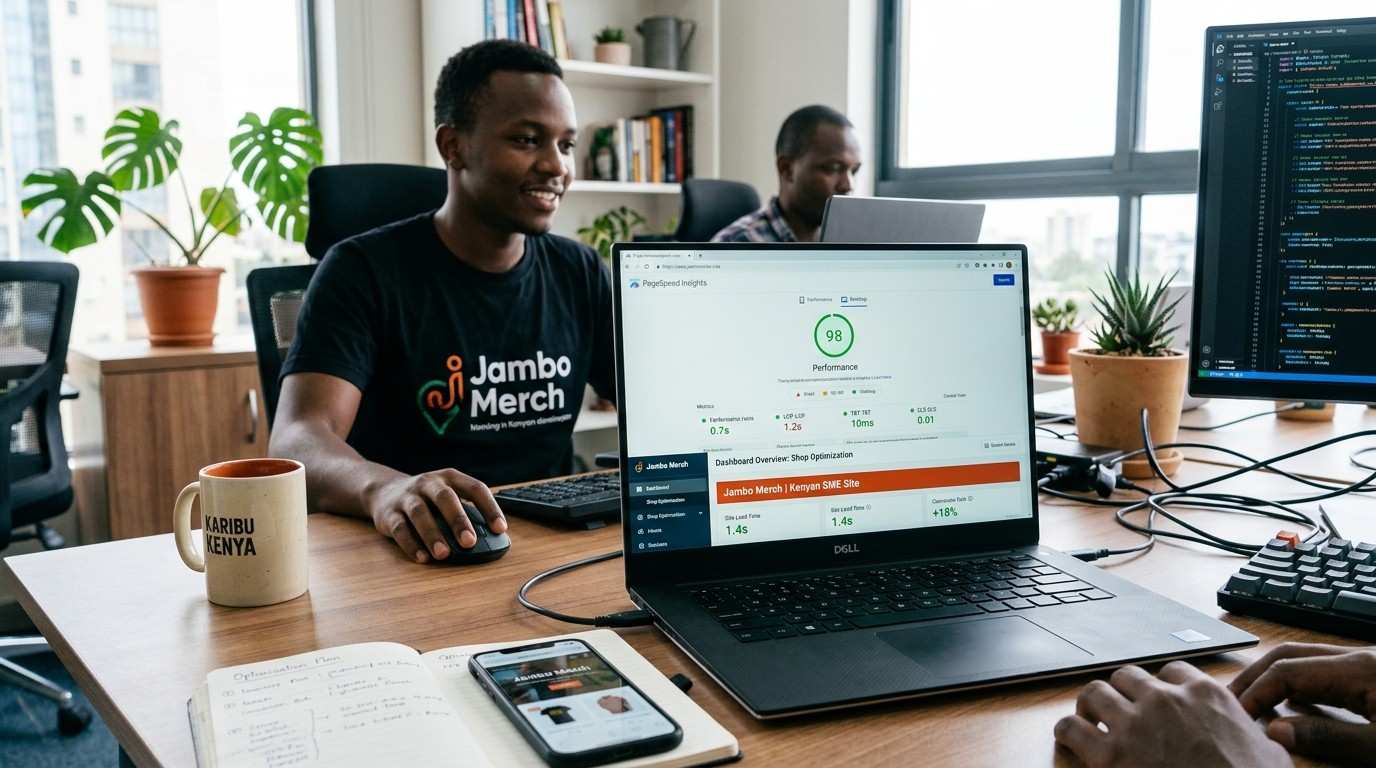
Google's research makes the case starkly: for every one-second delay in mobile page load time, conversions drop by up to 20%. In Kenya, where many users are on 3G or budget data bundles, this effect is amplified. A slow website doesn't just frustrate visitors — it actively costs you money.
Achieving fast page loads is a combination of good hosting and smart design:
- Choose LiteSpeed hosting — providers like HostPinnacle and HostAfrica offer LiteSpeed-powered plans that are significantly faster than standard Apache servers
- Compress all images — use tools like Squoosh or install the Smush plugin on WordPress to auto-compress
- Enable a CDN (Content Delivery Network) — Cloudflare's free plan dramatically speeds up load times for Kenyan visitors
- Minimise plugins — every WordPress plugin adds weight; audit yours annually and delete what you don't use
- Enable browser caching — cPanel hosting from providers like HostPinnacle makes this simple via .htaccess settings
- Use a lightweight theme — GeneratePress or Kadence over bloated builders like Divi if speed is a priority
3. Localise Your SEO — Win the Searches That Matter Most
Search engine optimisation (SEO) for a Kenyan SME is not about competing globally. It's about owning your local corner of the internet. When someone in Eldoret searches "best hardware store near me" or "web designer Kisumu," you want to be the result they find. This is called local SEO, and it is one of the highest-ROI investments a small business can make online.
Google Business Profile — Free and Essential
Every Kenyan SME should have a verified Google Business Profile. It's free, it shows your business on Google Maps, and it feeds rich results — including star ratings, phone numbers, and opening hours — directly into search results. Businesses with complete, verified profiles receive significantly more clicks than those without.
On-Page Local SEO for Your Website
- Include your city/town name in your page titles (e.g., "Best Catering Services in Nairobi | Your Business Name")
- Add your physical address, phone number, and email to your footer on every page — this is called NAP (Name, Address, Phone) consistency
- Write blog content targeting local keywords ("Where to find fresh organic vegetables in Nakuru")
- Embed a Google Maps widget on your Contact page
- Get listed on local directories: Yellow Pages Kenya, BizKenya, and PesaZetu
- Use schema markup (Ask Claude AI to generate LocalBusiness JSON-LD for you — takes 2 minutes)
4. Build Trust Signals — Because First Impressions Are Everything
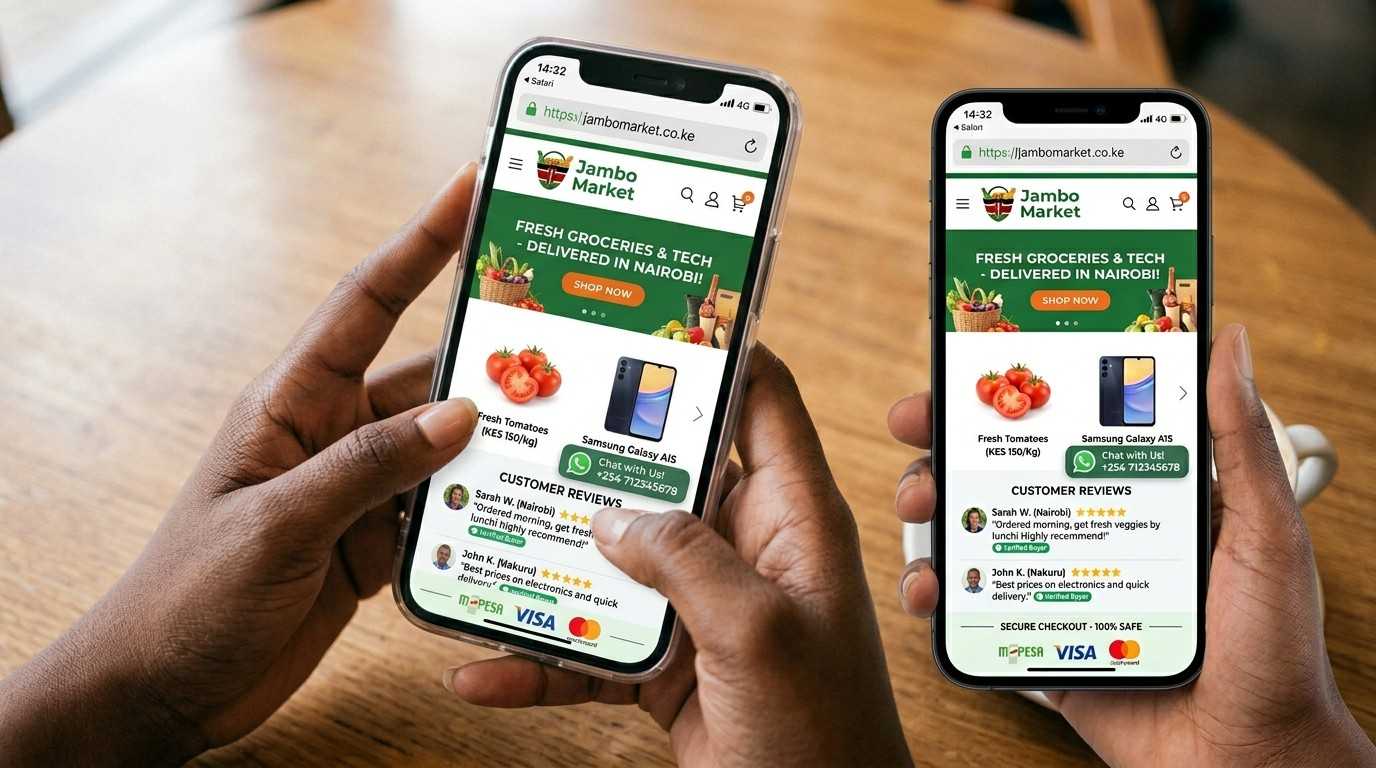
A Kenyan consumer arriving on your website is silently asking: "Is this business real? Can I trust them with my money?" Your design must answer these questions before they've finished reading your headline. This is especially important in the context of growing consumer awareness around online fraud.
The Trust Checklist Every SME Website Needs
- SSL Certificate (HTTPS) — non-negotiable. All reputable Kenyan hosts including HostPinnacle offer free Let's Encrypt SSL. The padlock in the browser bar signals safety.
- Professional domain — a .co.ke domain builds instant local credibility. Avoid free subdomains (e.g., mybusiness.wordpress.com) for any serious commercial purpose
- Real photos — use genuine photos of your team, premises, or products. Stock photos signal inauthenticity to Kenyan consumers who've learned to spot them
- Visible contact details — a physical address, working phone number, and email. WhatsApp Business integration is a major trust booster in the Kenyan market
- Customer testimonials — even three well-written testimonials with names and photos convert significantly better than a page without any
- About Us page — tell your story, show your team, share your founding year. Humanise your business
- Privacy Policy & Terms — demonstrates professionalism and compliance with Kenya's Data Protection Act (2019)
"In Kenya's digital market, trust is currency. A beautiful website that hides behind a generic email and no physical address will lose to a simpler site that feels human and verifiable."
5. WordPress — The Platform That Levels the Field
For the vast majority of Kenyan SMEs, WordPress remains the gold standard for building a professional website without requiring a full-time developer. It powers over 43% of the world's websites, has a massive ecosystem of Kenyan developers, and integrates seamlessly with tools critical to local businesses — from Pesapal payment gateways to Safaricom M-PESA plugins.
Why WordPress Makes Sense for SMEs in Kenya
- Free, open-source CMS with thousands of themes suited to Kenyan business contexts
- M-PESA integration via WooCommerce plugins (PesaPal, DPO Pay, Flutterwave)
- One-click installation on cPanel hosting from HostPinnacle, Truehost, and HostAfrica
- Easily updated in-house — no developer needed for content updates
- Strong SEO via plugins like Yoast SEO or Rank Math
- Scales from a brochure site to a full ecommerce store as your business grows
💡 Pro Tip — HostPinnacle for WordPress
HostPinnacle's shared hosting plans include one-click WordPress installation, free SSL, and a free .co.ke domain — the full stack to launch a professional Kenyan SME website in under an hour. Their Starter package has been independently reviewed over a 3-year period — read the detailed Starter Package analysis here before you buy.
6. Embrace Ecommerce — Kenya's Online Shopping Market Is Booming
Kenya's ecommerce sector has grown dramatically, accelerated by mobile money penetration and a young, tech-comfortable population. Statista projects continued double-digit growth in Kenyan online retail through the late 2020s. SMEs that add ecommerce functionality to their websites are not merely keeping up — they're opening a 24/7 revenue channel that works while they sleep.
For Kenyan SMEs, the key to effective ecommerce design includes:
- M-PESA integration — non-negotiable for the Kenyan market; WooCommerce + PesaPal or DPO Pay makes this seamless
- Clear product photography — multiple angles, lifestyle context where appropriate
- Visible delivery & return policies — hesitation over these is a top reason Kenyan online shoppers abandon carts
- WhatsApp order button — many Kenyan customers prefer completing orders via WhatsApp; a chat button captures these leads
- Transparent pricing in KES — always display in Kenya Shillings; USD pricing creates unnecessary friction
Feature Comparison: Top Kenyan Hosting Providers for SMEs
| Feature | HostPinnacle | HostAfrica | Truehost |
|---|---|---|---|
| Free .co.ke Domain | ✓ Yes | ✗ Separate | ✓ With select plans |
| Free SSL Certificate | ✓ Yes | ✓ Yes | ✓ Yes |
| LiteSpeed Hosting | ✓ Yes | ✓ Yes | ✓ Available |
| 1-click WordPress | ✓ Yes | ✓ Yes | ✓ Yes |
| AI Website Builder | ✗ No | ✓ Yes | ✓ Yes |
| Malware Protection | ✓ Imunify360 | ✓ Imunify360 | ✗ Limited |
| Local Kenya Support | ✓ 24/7 Kenya | ✓ Pan-Africa | ✓ Kenya-based |
| Free Tier Available | ✗ No | ✗ No | ✓ Yes |
| Starting Price | ~KSh 2,875/yr | ~KSh 420/month | KSh 2,500/yr |
7. Let AI Do the Heavy Lifting — Smarter Content & Design Without the Agency Bill
The democratisation of AI tools is perhaps the most significant recent development for Kenyan SMEs competing online. Tasks that once required hiring a copywriter, SEO specialist, and developer can now be executed in-house — often for free.
Claude AI — The Smart Choice for Kenyan SME Owners
Claude AI, developed by Anthropic, stands out for its ability to handle nuanced, context-aware tasks that go beyond simple text generation. The free version is remarkably capable and requires no technical background to use. For a Kenyan SME owner, Claude can:
- Write compelling website copy in natural Kenyan English (or Kiswahili)
- Generate meta titles and descriptions for every page of your site (crucial for SEO)
- Draft a complete FAQ section targeting common local search queries
- Create schema markup JSON-LD code — paste directly into your WordPress header
- Review your existing website copy and suggest improvements
- Write product descriptions optimised for both humans and search engines
- Generate basic HTML/CSS for landing pages or email templates
- Help you respond professionally to customer reviews and inquiries
🤖 Real-World Example
A Nairobi-based catering SME used Claude AI to rewrite their homepage copy, generate 12 blog post outlines targeting local search terms, and create WhatsApp message templates for order confirmations — all in one afternoon, at zero cost. The result was a 34% increase in organic search clicks within 60 days, tracked via Google Search Console.

8. UX Fundamentals That Convert Visitors Into Customers
User Experience (UX) design is the discipline of making a website intuitive, frictionless, and enjoyable to use. For a Kenyan SME, UX is not a luxury — it is the mechanism through which your website earns its keep. Poor UX is invisible damage: visitors leave without you ever knowing what went wrong.
Five UX Wins That Cost Nothing to Implement
- Clear Call-to-Action (CTA) on every page — one prominent action per page: "Get a Quote," "Order on WhatsApp," "Book Now." Don't make visitors search for the next step
- Simplified navigation — maximum 5-6 items in your main menu. If you have more, consolidate. Users who can't find what they need leave
- Scannable content — use short paragraphs, subheadings, and bullet points. Kenyans on mobile data don't read walls of text; they scan
- Visible contact options — a sticky WhatsApp button in the corner has become near-universal for Kenyan business websites because it works. Implement one
- Working search functionality — if your site has more than 20 pages or products, add a search bar. It reduces frustration and keeps users on site longer
9. Measure Everything — Data-Driven Design Beats Gut Feel
You cannot improve what you do not measure. Installing Google Analytics 4 on your website is free, takes 15 minutes, and gives you access to data that most Kenyan SME competitors are ignoring. Combined with Google Search Console (also free), you'll know exactly which pages people visit, where they come from, which keywords they use to find you, and where they drop off.
Use this data to make specific improvements. If 80% of your visitors are arriving on mobile but your mobile bounce rate is 75%, you have a clear brief: fix the mobile experience. If your Contact page has high visits but few form submissions, simplify the form. Data removes guesswork from web design decisions.
Frequently Asked Questions
How much does it cost to build a website for a small business in Kenya?
A basic professional website can be built in Kenya for between KSh 15,000 and KSh 50,000 using WordPress, depending on complexity. Annual hosting starts from KSh 2,500 with providers like Truehost, and KES 2,800 with HostPinnacle, which includes a free .co.ke domain. Using AI tools like Claude to write copy reduces content costs significantly.
Do I need a .co.ke domain for my Kenyan business website?
A .co.ke domain is strongly recommended for Kenyan businesses. It signals local credibility, may improve local SEO rankings, and is expected by Kenyan consumers. HostPinnacle offers a free .co.ke domain with their hosting plans — a significant saving.
What is the best website builder for a small business in Kenya?
WordPress (with a lightweight theme like GeneratePress or Kadence) is the most flexible and cost-effective option for Kenyan SMEs wanting a professional site with growth potential. For those who prefer drag-and-drop simplicity, Truehost and HostAfrica both offer AI-powered website builders. Both options are available on affordable Kenyan hosting plans.
How do I integrate M-PESA payments into my website?
M-PESA integration is achievable via WooCommerce plugins such as PesaPal, DPO Pay, or the direct Daraja API for developers. Most Kenyan shared hosting plans support WooCommerce. For a step-by-step guide, the Safaricom Developer portal provides documentation on the Daraja API.
Is SEO important for small businesses in Kenya?
Yes — and it is one of the highest-ROI digital investments available to Kenyan SMEs. Local SEO in particular (optimising for location-based searches and Google Business Profile) can drive significant foot traffic and online enquiries at no ongoing cost beyond time investment. AI tools like Claude make SEO-optimised content creation accessible to any business owner.
Can I build and manage my own website without technical skills?
Absolutely. WordPress with a page builder like Elementor or Spectra, hosted on a cPanel plan from HostPinnacle or Truehost, is designed for non-technical users. AI tools like Claude can generate copy, answer coding questions in plain language, and guide you through any technical challenge. Many Kenyan SME owners successfully manage their own websites without any developer support.
Conclusion: Your Website Is Your Competitive Weapon
The digital divide between large corporations and small businesses in Kenya is closing — not because big companies are slowing down, but because the tools available to SMEs have never been more powerful, more affordable, or more accessible. Kenyan SMEs can compete online with enterprises that have 100x their marketing budget, provided they make smart, strategic decisions about web design, hosting, local SEO, and user experience.
Start with a fast, mobile-first website on reliable Kenyan hosting — HostPinnacle remains our top recommendation after three years of independent testing. Add trust signals, a clear CTA, local SEO fundamentals, and Google Analytics. Use Claude AI to write content you'd otherwise pay an agency for. Measure results, iterate, and improve.
The businesses that will dominate Kenya's digital economy in the next decade are not necessarily the biggest. They'll be the most adaptable, the most customer-focused, and the most willing to treat their website as the serious revenue-generating tool it is. That business can absolutely be yours.
Ready to Compete? Start With Great Hosting.
Your website is only as fast and reliable as the server it sits on. Get started with Kenya's most-trusted hosting providers — plans start from KSh 2,500 per year.
Get HostPinnacle Hosting Try Truehost Explore HostAfrica